

Window sills with a rolled bead: why sheet metal workers make them and how it is done
The fabrication of window sills is one of the key sheet metal jobs on any building. It is not part of the roof, yet it protects the structure against water around windows and various recesses.
Three types of window sill you will come across on site
-
- Extruded aluminium sills – quick, cheap, mass-produced. Limited in both dimensions and shape, and the plastic end caps crack over time.
- Galvanised sheet steel sills with plastic end caps – a compromise solution; the end caps are the weak point.
- Sills fabricated by a sheet metal worker – made to measure, any length and projection, clean corners, long service life.
And it is precisely the fabrication and installation of sheet-metal sills that we will look at in more detail.
Fabricating window sills the sheet metal way
Here we distinguish further between:
- square-edged sills – by far the most widespread method of fabrication and installation.
- sills with a rolled bead.
We will go through the fabrication of sills with a rolled bead, as this is the more demanding method.
Window sills with a rolled bead
The sill is the detail on a façade that is seen first from the street — and at the same time it is the place where it shows fastest whether the work was done by a professional or by “someone with a folder”. A rolled bead is exactly the feature that separates a cheap solution from genuine sheet metal craftsmanship. To fabricate a sill of this kind, sheet metal workers need the following equipment:
- A folding machine with integrated bead rolling
- A bead-rolling aid
- A bead-rolling machine
- A slip roll bender for curving
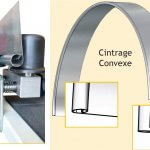
What a bead is and what it is good for
- Stiffness. The rolled edge acts as a stiffener, so the sill will not sag even at a greater projection.
- Safety. No sharp sheared edge next to the window.
- Drip function. Water breaks away from the edge instead of running down the façade — fewer dirty streaks beneath the window.
- Appearance. A soft, solid edge looks far more valuable than a plain fold. It is a typical detail on both historic buildings and high-quality new builds.
The equipment you need for the job
| Machine or tool | What it is used for |
|---|---|
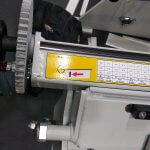
| Jouanel PCX 3080A folding machine with integrated bead rolling | Complete fabrication of the sill, including the bead, on a single machine |
| T-shaped bead-rolling bar (36 cm, ø 13 mm) | Hand tool for finishing the bead and the corners |
| CMB ET bead-rolling machine | Accurate, repeatable production of beads |
| BKK 50 slip roll bender (5–50 mm) | Rolling curves and larger radii |
| Jouanel HS33 segmented folder (1270 mm) | Square-edged sills and more complex profiles |
Step-by-step fabrication procedure
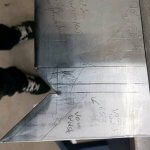
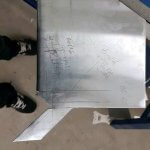
- Measuring and marking out. Measure the width of the opening, including the return into the reveal, and the projection required in front of the façade. Transfer the layout onto the sheet.
- Cutting. Cut the developed width, including the allowance for the bead and the rear folds.
- Corner notching. At the side upstands, notch the sheet so that the corner can be folded without the material being forced through — this is where craftsmanship shows most clearly.
- Rear fold. The rear edge runs under the window frame, with a back fall against water ingress where required.
- Rolling the bead. The front edge is gradually curled into a cylinder — in several passes, not in one go. Forcing it through in a single pass will ripple the sheet.
- Side terminations. Folded upstand corners, or the bead dressed into the reveal. The external corner on a beaded sill is the detail on which the whole impression of the work depends.
- Inspection and installation. The sill is set with a fall away from the window, on a packed substrate, leaving room for expansion on long pieces.
Common mistakes you can avoid
- Zero or reversed fall – water stands on the sill or runs back under the frame.
- Rigid fixing along the whole length – the sheet expands with temperature and the sill ripples; long pieces must be split and allowed to move.
- Insufficient projection – dripping water ends up on the façade rather than clear of it.
- A bead rolled “in one pass” – a deformed, rippled edge that cannot be rescued.
- Incorrect sheet thickness – material that is too thin will buckle at the bead regardless.
You might also be interested in
Gallery
Here you will find the accompanying images

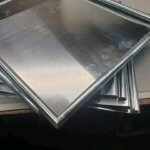
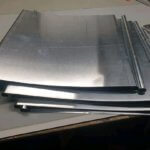
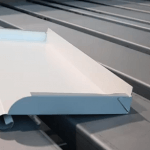
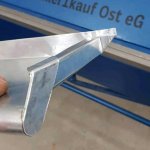


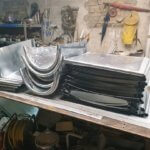
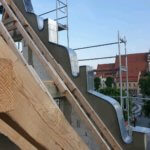
Square-edged sills
Next we will show you how to fold them correctly, so take a look at how these sills can be produced by machine on a segmented folder:


