
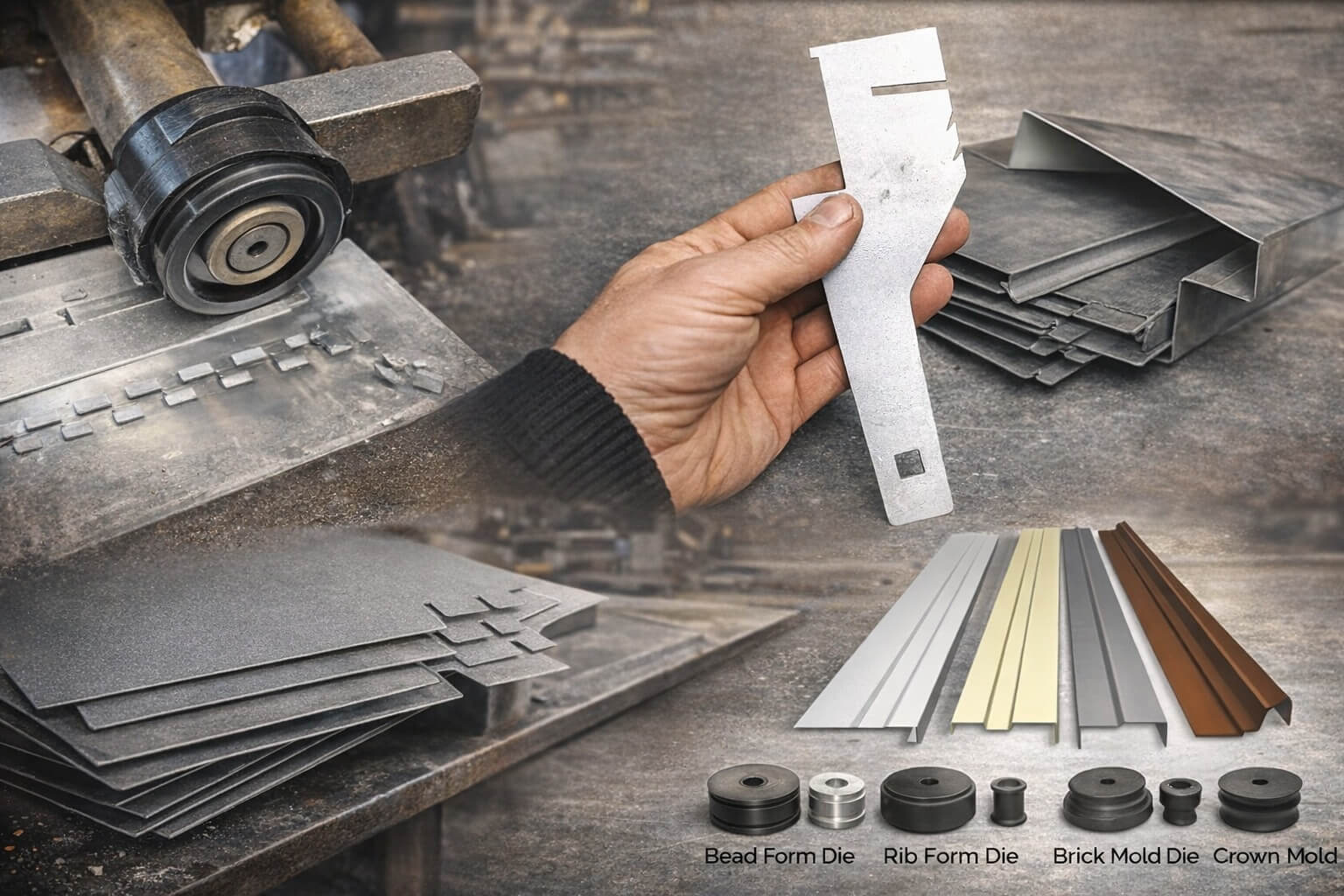
At the beginning of 2026, a significant rise in steel prices is evident, putting pressure on every manufacturing, assembly and trading company. Cost savings are therefore essential, particularly in terms of production inputs – how to speed up and make production and on-site assembly more efficient. Last but not least, a very interesting way to reduce these costs is the utilization of waste and sheet metal offcuts.
In the following paragraphs, I will outline our perspective on the processes in every sheet metal company where savings are possible, and how production costs can be stabilized as a result.
1. Production of Perforated Sheet Metal and Ventilation Strips Using a Scoring Tool
One of the most effective ways to make use of waste and sheet metal offcuts is the production of perforated sheet metal directly in the workshop. The scoring tool allows you to create exactly the holes you need – without having to order expensive perforated sheet metal from an external supplier.
Typical applications include:
- Ventilation strips – an essential element of every correctly installed roof. They ensure air circulation under the roofing and prevent moisture condensation.
- Decorative openings in sheet metal cladding – modern facades and parapets increasingly use perforated sheet metal as both an aesthetic and functional element.
- Gravel strips – perforated sheet metal is also used in the production of gravel strips, which prevent the drainage system from becoming clogged with debris.
The advantage of the scoring tool lies in its versatility – one machine handles multiple operations, which significantly reduces investment costs. Sheet metal offcuts that would otherwise end up as waste are thus transformed into a marketable product with added value.
More information can be found here.
2. Preparation of Sheet Metal Elements and Their Profiling Using Scoring Wheels
Scoring wheels are a simple yet extremely effective tool for pre-marking bends and profiling sheet metal directly in the workshop or on the construction site. Their use significantly reduces the time required for material preparation and minimizes errors during bending.
A roll bending machine with interchangeable scoring wheels enables:
- Fast and precise profile preparation without the need for measuring and manual marking
- Wheel replacement according to profile type – every sheet metal worker can set up the machine exactly according to their needs
- Production of repeating elements with high quality and consistent execution
The investment in this device pays off with the first larger orders requiring serial production of identical profiles.
More information can be found here.
3. Bending of Facade Cassettes (MARCUS Templates)
Facade cassettes are a highly sought-after product today. Architects and investors appreciate them for their clean appearance and long service life. However, producing facade cassettes directly in a sheet metal workshop requires the right tools and above all precise templates.
MARCUS templates are designed to enable fast and repeatable production of cassettes in the two most popular systems:
- Standing seam – a classic seam system that is popular for its aesthetics and resistance to weather conditions.
- Click system – a modern solution that allows faster installation and easier removal in the event of repairs.
Using templates significantly shortens production time, reduces the number of defective pieces and the overall quality of products becomes consistent. This has a direct impact on cost reduction and increased customer satisfaction.
More information can be found here.
4. Preparation of Sheet Metal for Chimney Flashing in the Workshop
Chimney flashing is one of the most demanding details on a roof. Every chimney has different dimensions, a different roof pitch and different requirements for the shape of the flashing. This is precisely why preparation in the workshop – using a chimney template – is far more efficient than improvising directly on the roof.
The chimney template enables:
- Accurate measurement and transfer of chimney dimensions onto sheet metal before climbing onto the roof
- Preparation of all flashing components in the warm and comfortable workshop
- Significant time savings during the actual installation – the sheet metal worker arrives on the roof with finished parts that only need to be fitted
- Minimization of errors and therefore unnecessary material waste
The result is faster installation, lower material consumption and a professional finish that customers will appreciate.
More information can be found here.
5. Punching to Templates
Punching is a process that enables precise cutting of shapes from sheet metal according to pre-prepared templates. It is a fast and effective alternative to manual cutting that guarantees repeatability and accuracy of every piece.
In practice, the following technologies are mainly used:
- AWG – punching for the production of facade cassettes and decorative elements
- BK1 – suitable for the preparation of corner and transition elements
- V-CUT – a notching technique for sheet metal that enables bending at sharp angles without a visible seam on the surface
Punching to templates is ideal for serial production where the same shape is repeated in larger quantities. The investment in the right tool is reflected in reduced production time and the quality of the final product.
More information can be found here.
6. Production of Clips K10-FH
Clips are an integral part of every seam roof. They ensure firm attachment of the roofing to the substrate while allowing thermal expansion. Purchasing them from an external supplier can be costly – especially for larger orders.
The machine for producing fixed clips K10-FH enables the production of clips directly in the workshop:
- From your own sheet metal offcuts, thereby reducing waste
- In exactly the required quantity – without the need to order more than necessary
- With consistent quality and dimensions that meet standards
Producing your own clips is one of the simplest and at the same time most effective ways to reduce material costs in a sheet metal workshop.
More information can be found here.
7. Optimization of Warehouse Processes
Efficient warehouse organization is the foundation of every successful sheet metal workshop. Unnecessary searching for materials, damaged coils or inefficient use of space – all of this directly increases costs and reduces productivity.
Key measures for warehouse optimization:
- Rewinding coils – allows a large coil to be divided into smaller parts according to current needs, eliminating unnecessary waste
- Stack storage – suitable racks and coil stands save space in the workshop while protecting the material from damage
Investing in quality warehouse equipment is reflected not only in space savings, but also in overall clarity and faster access to materials.
More information can be found here.
8. Production of Window Sills from Higher Quality Materials
Window sills are a product where material quality is directly reflected in the price the customer is willing to pay. Switching from ordinary steel to premium materials can be an excellent opportunity for a sheet metal company to increase its margins.
The most sought-after materials include:
- Titanium zinc in various shades – popular for its long service life, natural patination and modern appearance. Available in shades ranging from anthracite to pre-patinated grey.
- Copper – a premium material with exceptional aesthetics and a service life exceeding 100 years. Copper window sills are a sought-after product in the renovation of historic buildings as well as modern constructions.
The production of window sills from these materials requires the right machines and technologies – for example, bending machines with a crushed fold function that ensure professional execution even with more demanding profiles.
9. Offering New Services to Customers
Expanding the service portfolio is one of the most effective ways to increase turnover without the need for large investments in new equipment. Many sheet metal companies have machines that are capable of offering much more than their owners currently use.
Services with high potential include:
- Rewinding coils – dividing large coils into smaller ones according to customer requirements
- Slitting – cutting the coil into narrower strips of precise width
- Cut-to-length – cutting the coil into sheets of precise length
- Sheet metal laminating – protecting the sheet metal surface with film against scratching during transport and installation
These services can be offered to other sheet metal workers, construction companies or directly to end customers. It is a relatively simple way to generate additional income from existing capacities.
More information can be found here.
10. CNC Bending
CNC bending represents the next step in the automation of the production process. Modern CNC bending machines allow entire bending sequences to be programmed, which is ideal for the serial production of standard profiles.
Advantages of CNC bending:
- Library of standard profiles – once programmed, profiles can be recalled and produced at any time without the need to reset the machine
- New products in the production process – CNC technology opens the door to the production of more complex profiles that could not be produced manually with sufficient precision and repeatability
The investment in a CNC bending machine is higher, but with regular use the payback period averages 2–4 years. Companies that have taken this step report a significant increase in productivity and a reduction in the number of production errors.
More information can be found here.
I firmly believe that our solutions will inspire you to find ways to reduce costs in production, and we would be delighted if you contacted us.


